
Discipleship and Discipline in Budgeting
Disciple, Discipline, and Parish Budgeting
The words disciple and discipline share a common root in the Latin discipulus, meaning “pupil.” That shared origin matters—especially when we talk about parish ministry budgeting.
At the end of this post, you’ll find a free ministry budgeting tool designed to help you explore this idea in a practical, accessible way.
Discipline as a Tool for Growth
When we hear disciple, we often think of Jesus and the Twelve—or more broadly, of someone who follows a teaching because it is compelling and life-giving.
When we hear discipline, we may think of punishment, or of rigorous self-control. For parish life, it is this second meaning—intentional, sustained practice—that matters most. Discipline is not about restriction. It is about creating the conditions for growth.
Parish Ministries Begin with Mission
Ministries flourish when people feel called to gather around a shared purpose. In a parish, that purpose is always rooted in Christ. These ministries represent what Scripture calls “treasure in heaven” (Matthew 6).
But heavenly treasure must be sustained in a temporal world—one shaped by limited resources. (Canon Law Book V)
That is where budgeting enters the picture.
Ministry leaders may ask: Why do we need a budget? We’re just a ministry—isn’t this overkill?
The answer is no. It is not overkill. It is an invitation.
An invitation to participate more fully in the life of the parish.
If you are being asked to create a ministry budget, don’t see it as a test or a burden. See it as a sign of trust—an acknowledgment that your ministry matters and belongs within the larger stewardship of the parish.
What Disciplined Ministry Budgeting Makes Possible
Disciplined ministry budgeting does several important things at once:
It invites ministry leaders into shared stewardship, alongside the pastor and leadership councils, starting from what they know best: ministry activity.
It creates space for learning and dialogue, helping leaders understand the financial realities of parish life in context.
It grounds mission in sustainability. Even deeply mission-driven work—feeding the hungry, welcoming families, forming disciples—depends on real resources that must be planned for and maintained.
It brings transparency to parish finances. When pastors can clearly explain fixed costs and available income, ministry leaders can better understand constraints, tradeoffs, and opportunities.
For example, a pastor might share: “We spend about $50,000 per month on salaries, insurance, utilities, and other core expenses. On average, parish income is about $52,000 per month.” That simple clarity allows ministry leaders to see the whole picture—and to steward their ministries accordingly.
A Practical Next Step
To help parishes move from theory to practice, I’ve created a free ministry budgeting tool you can use to explore these ideas with clarity and confidence. It is designed to be:
Accessible for ministry leaders
Grounded in real parish realities
Useful for thoughtful conversation—not just numbers
Access the tool below. Use it as a free spreadsheet or just read it and create your own version on paper. Make this your own.
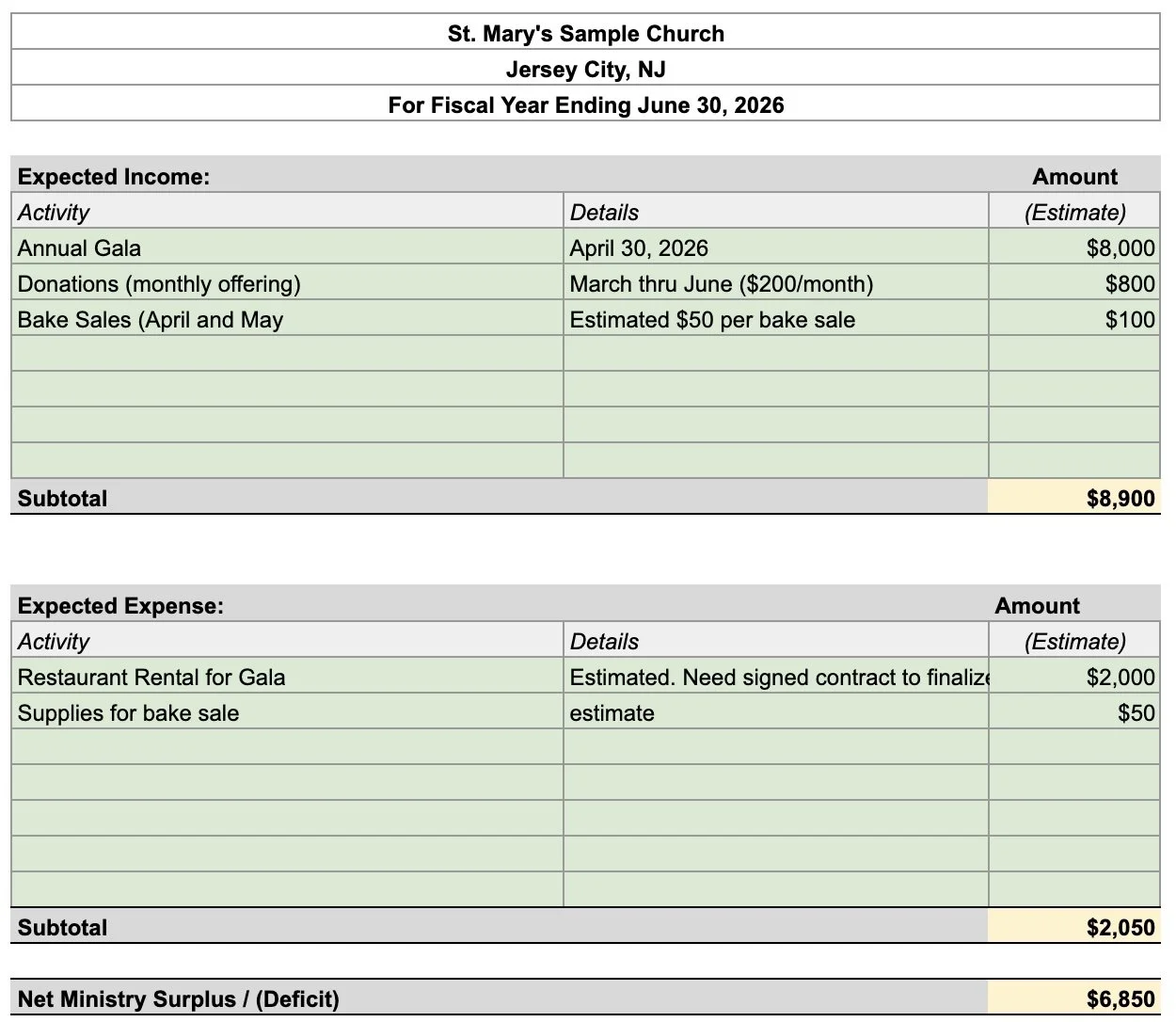
Free Ministry Budget Template
This template is free to download.
Please provide your name and email so I can understand who is using these resources. Your contact information is not shared or used for any other purpose. If you have feedback or would like to connect about parish finance tools or support, you’re welcome to leave a message.
For parishes seeking structured support, my parish advisory and consulting services are outlined here.
